How to Efficiently Recycle Used Tires and Produce High-Value Rubber Granules?
In the tire recycling industry, how to efficiently convert used tires into high-value rubber granules has always been a key […]
In the tire recycling industry, how to efficiently convert used tires into high-value rubber granules has always been a key challenge. Today, we will introduce a complete solution that not only solves this problem but also significantly improves the overall efficiency of tire recycling.
1.What is a Rubber Granulation and Fiber Removal System?
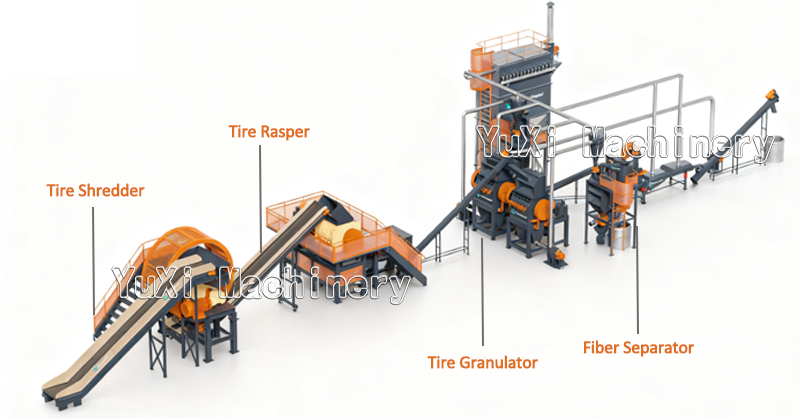
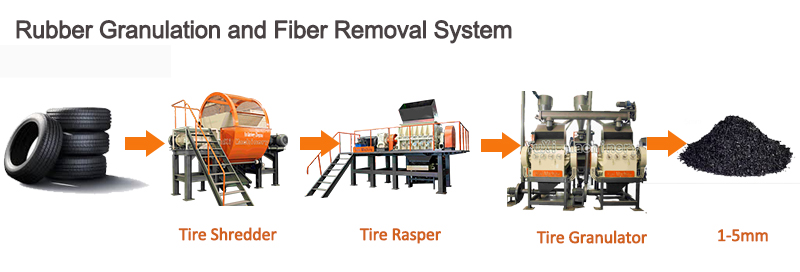
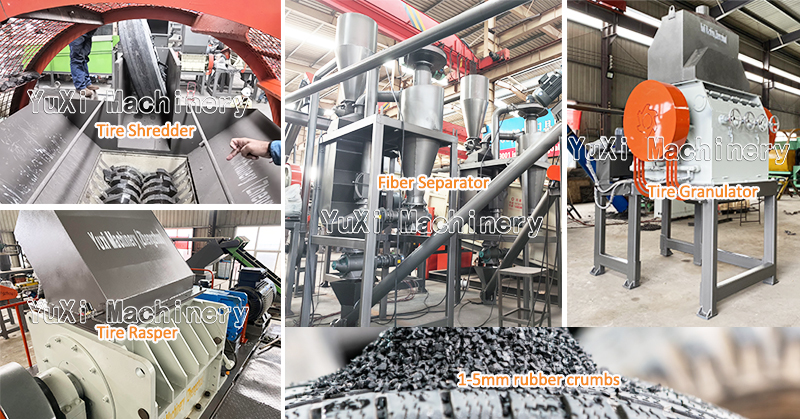
This is the core component of used tire recycling. The system includes a rubber granulator, zigzag air separator, and pulse dust removal system, which can process rubber granules to a particle size of 1-5 mm. During this process, most of the nylon fibers are separated and collected. Rubber crumbs can be used to produce various products, such as rubber floor tiles, running tracks, and molded products.
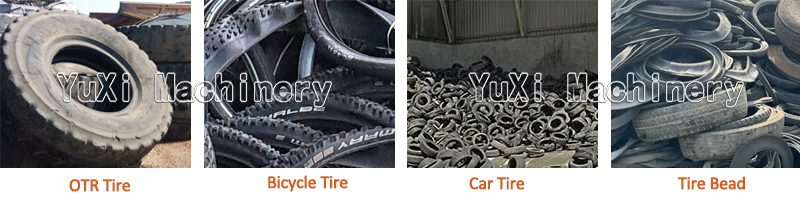
The system is robust and adaptable, capable of efficiently handling various common used tires and rubber products:
Passenger car tires
Truck tires
Other rubber products (configurable based on equipment)
3.System Workflow: From Used Tire to High-Purity Product
The workflow of this system consists of four key steps:
Powerful Shredding: Used tires (passenger car and truck tires) are first shredded by a tire shredder into rubber chunks measuring 2-6 inches, preparing them for subsequent fine separation.
Steel Wire Separation: The rubber chunks enter the tire wire separator, where high-speed rotation and physical friction completely separate the rubber from the embedded steel wires.
Fiber Removal: After wire separation, the rubber chunks still contain some fibers. The fiber separator uses air separation or vibrating screening to effectively remove these lightweight fibers, ensuring the purity of the rubber raw material.
Fine Granulation: The purified rubber chunks are fed into the granulator, where they are extruded and die-cut into uniformly sized, clean rubber granules measuring 0.04-0.2 inches. The separated steel wires are also collected and packaged.
4.System Features: Efficient, Pure, Energy-Saving
This system has four significant features:
High Efficiency and Yield: The automated production line design provides strong processing capacity and continuous stable operation, significantly improving recycling efficiency.
Pure Product: The multi-stage separation process (wire separation + fiber separation) ensures the production of high-purity, low-impurity, and high-market-value rubber granules.
Fast Return on Investment: Converting used tires into directly marketable rubber granules and steel creates sustainable economic benefits.
Durable: The core components of the equipment are made of high-strength, wear-resistant materials, capable of withstanding the harsh conditions of tire shredding and ensuring a long service life.
5.Practical Application Cases
In practical applications, this system has proven its value in multiple recycling projects:
Case 1: After introducing this system, a tire recycling plant increased its overall processing efficiency by 30%.
Case 2: A large tire recycling enterprise increased the purity of its rubber granules by 25% after using this system.
Case 3: An environmental project significantly improved the market value of rubber granules by using this system.
6.Future Development Trends
With increasing environmental requirements and technological advancements, this system is continuously evolving:
Intelligentization: Integrating AI and machine learning technologies to achieve more precise separation and equipment self-optimization.
Modularization: Adopting modular design for flexible configuration based on different processing volumes.
Automation: Integrating with other recycling equipment to achieve fully automated processes.
Customization: Providing personalized solutions based on different customer needs.
7.Selection Recommendations
When selecting this system, consider the following factors:
Processing Capacity: Choose the appropriate model based on the expected daily processing volume.
Compatibility: Ensure the system can handle the types of tires you need to process.
Maintenance Requirements: Choose a system that is easy to maintain and has readily available spare parts.
Technical Support: Ensure the supplier can provide timely technical support and training.
The rubber granulation and fiber removal system is more than just a piece of equipment; it is an innovator in the tire recycling industry. It solves a major challenge in tire recycling, improves overall efficiency, reduces processing costs, and makes a positive contribution to environmental protection. As technology continues to advance, we can expect this system to play an increasingly important role in tire recycling, making greater contributions to building a circular economy and promoting sustainable development.
Get Machine Price Now
Content for Specifications.
Content for Features.
Local Office
Henan University Science and Technology Park (Western) ,