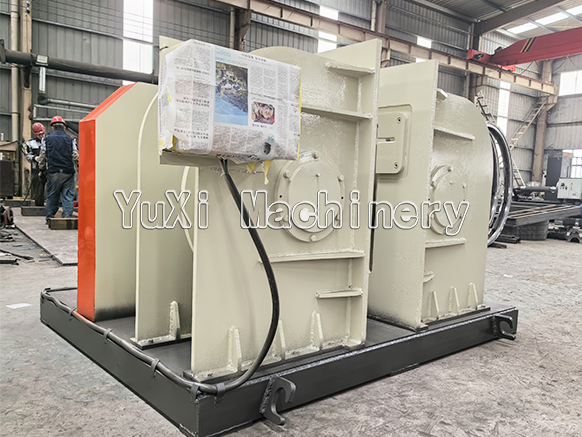
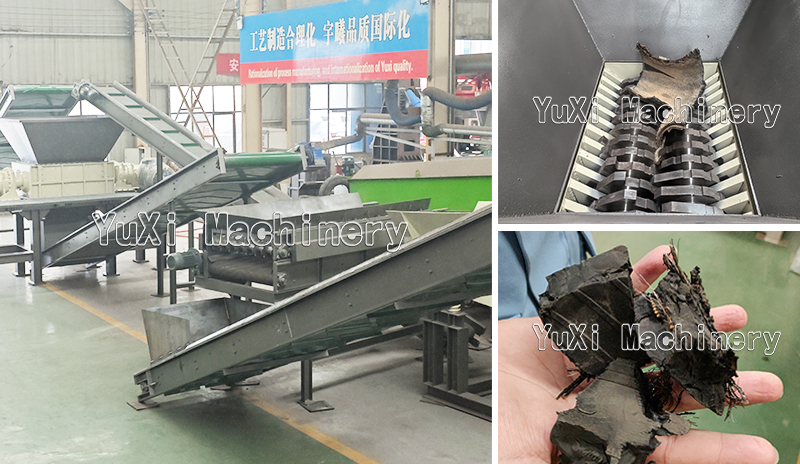
The Core Crushing Equipment for Waste Tire Recycling Tire Shredder
In the global waste tire recycling industry, the tire shredder serves as the core link connecting “preprocessing” and “fine processing.” […]
In the global waste tire recycling industry, the tire shredder serves as the core link connecting “preprocessing” and “fine processing.” Through physical crushing technology, it converts tough tire materials into uniform and controllable rubber granules—solving the pain points of large volume and difficult transportation of waste tires, while directly determining the quality of subsequent products such as rubber powder and reclaimed rubber. It is an indispensable key equipment in the recycling production line.
1.Applicable Materials: Covering Multiple Types of Tires and Rubber Materials
Tire shredders can efficiently process materials after different preprocessing procedures, including:
Strip-shaped materials cut by tire cutters (e.g., truck and engineering tire strips), from which the bead core has been removed for easy entry into the crushing chamber;
Block rubber materials remaining after steel wire separation by tire wire drawing machines, which can be directly crushed without secondary impurity removal;
Small and medium-sized whole waste tires (passenger car and motorcycle tires), which can be directly fed into some models without preprocessing;
Other waste rubber products (e.g., waste conveyor belts, seals), expanding the equipment’s application scenarios.
Whether it is steel-belted radial tires or all-rubber bias tires, efficient crushing can be achieved by matching the corresponding machine model, without the need for complex parameter adjustments.
2.Working Principle: Multi-Stage Crushing + Intelligent Screening for Uniform Granules
Tire shredders follow the logic of “progressive crushing + precise screening,” with the core process divided into four steps—each equipped with targeted designs:
Feeding Buffer: Inclined guide plates and anti-clogging devices prevent equipment overload caused by material accumulation, adapting to batch continuous feeding;
Primary Crushing: High-manganese steel crushing hammers break large materials into 50-100mm coarse granules through impact and shearing force. Some models simultaneously separate fine steel wires via magnetic separation;
Fine Crushing: Rolling rollers and cutter sets in the secondary crushing chamber further refine coarse granules into 10-30mm uniform granules, meeting different production needs of downstream processes;
Screening and Discharging: Vibrating screens (with replaceable apertures) separate qualified granules from coarse materials. Coarse materials are recycled for re-crushing, ensuring a finished product qualification rate of over 98%.
The entire process is automatically monitored by a PLC system, allowing real-time parameter adjustment and ensuring strong stability in continuous operation.
3.Core Advantages: Comprehensive Optimization from Efficiency to Cost
Compared with traditional equipment, modern tire shredders have four core advantages:
High Efficiency and Output: A single unit can process 1-5 tons per hour (depending on the model), 2-3 times that of traditional equipment. No adhesion or clogging issues occur, and continuous operation can last over 12 hours per day;
Precise and Controllable Granule Size: By replacing screens with 5-30mm apertures and adjusting hammer speed, the size error of granules is within ±2mm, adapting to different downstream standards;
Durability and Low Consumption: Crushing hammers and rolling rollers undergo hardening treatment, with a service life of 800-1200 hours (4-6 months) and no more than 4 maintenance sessions per year;
Energy Saving and Environmental Protection: 30-75kW variable-frequency motors can automatically adjust energy consumption, reducing no-load loss by 30%. Some models are equipped with dust collection devices, with dust emission concentration below 30mg/m³, eliminating the need for additional dust removal equipment.
4.Irreplaceable Role in the Recycling Industry Chain
Tire shredders play a key “connecting” role, directly affecting the efficiency and profitability of the production line:
Connecting Upstream: Convert irregular tire materials into standardized granules, solving the pain point of “unified feeding specifications” for subsequent equipment;
Empowering Downstream: Fine granules below 10mm can be processed into 80-120 mesh rubber powder (priced at 2000-3000 RMB/ton), while coarse granules of 20-30mm can be made into rubber floor tiles (priced at 800-1500 RMB/ton), realizing “one material for multiple uses”;
Cost Reduction and Efficiency Improvement: The volume of crushed granules is only 1/5-1/8 of the original tire, saving 70% of storage space and reducing transportation costs by 40%-50%.
5.Selection Guide: Matching the Optimal Model to Needs
When selecting a tire shredder, it is necessary to consider business scale, material type, and downstream planning, focusing on four key points:
Matching Processing Capacity: For daily processing of 5-10 tons, choose a small model (1-2 tons/hour, 30-45kW); for 20-50 tons/day, choose a medium-to-large model (3-5 tons/hour, 55-75kW);
Adapting to Material Characteristics: Choose models with magnetic separation for steel-belted tires, models with large feeding ports for whole small tires, and simplified models without magnetic separation for all-rubber materials;
Downstream Demand Orientation: For rubber powder production, choose models capable of crushing to below 10mm; for road base material production, choose models for coarse crushing to 20-30mm;
Prioritizing After-Sales Service: Select brands with local service outlets to ensure on-site maintenance within 24-48 hours, and confirm the supply cycle of wearing parts.
The application of tire shredders has expanded beyond single recycling scenarios to cover multiple industries:
Rubber Products Industry: Crush waste rubber products as raw materials for reclaimed rubber, replacing part of virgin rubber to reduce costs;
Road Construction: Use 20-30mm granules to make rubber-modified asphalt, improving the aging resistance and crack resistance of road surfaces;
Sports Facilities: Use 5-10mm fine granules to make rubber running tracks and basketball court surfaces, which are non-slip, shock-absorbing, and meet safety standards;
Landscaping and Municipal Engineering: Use 10-20mm granules to make rubber floor tiles and tree pit covers, which are lightweight, easy to install, and prevent falls.
7.Daily Maintenance: Key to Extending Equipment Life
Standardized maintenance ensures long-term stable operation of tire shredders, with core points including:
Daily Inspection (Before Startup): Check for wear or looseness of crushing hammers and rolling rollers, damage or clogging of screens, and oil level/pressure of the hydraulic system (if equipped);
Regular Cleaning (Once a Week): Clean residual debris in the crushing chamber, steel wires on magnetic separation devices, and dust on the equipment surface;
Lubrication Maintenance (Once a Month): Add special lubricating oil to drive bearings and gears, and replace filters for the hydraulic system;
Wearing Parts Replacement: Replace crushing hammers when the blade edge wear exceeds 5mm and screens when damaged. Prioritize original accessories.
Conclusion
For waste tire recycling enterprises, the tire shredder is not just a crushing device, but a core tool connecting the entire “recycling-processing-sales” chain. Through efficient crushing, precise granule control, and multi-scenario application, it helps enterprises reduce costs and improve efficiency, while promoting the development of waste tire resource utilization toward a more environmentally friendly direction.
Get Machine Price Now
Content for Specifications.
Content for Features.
Local Office
Henan University Science and Technology Park (Western) ,