
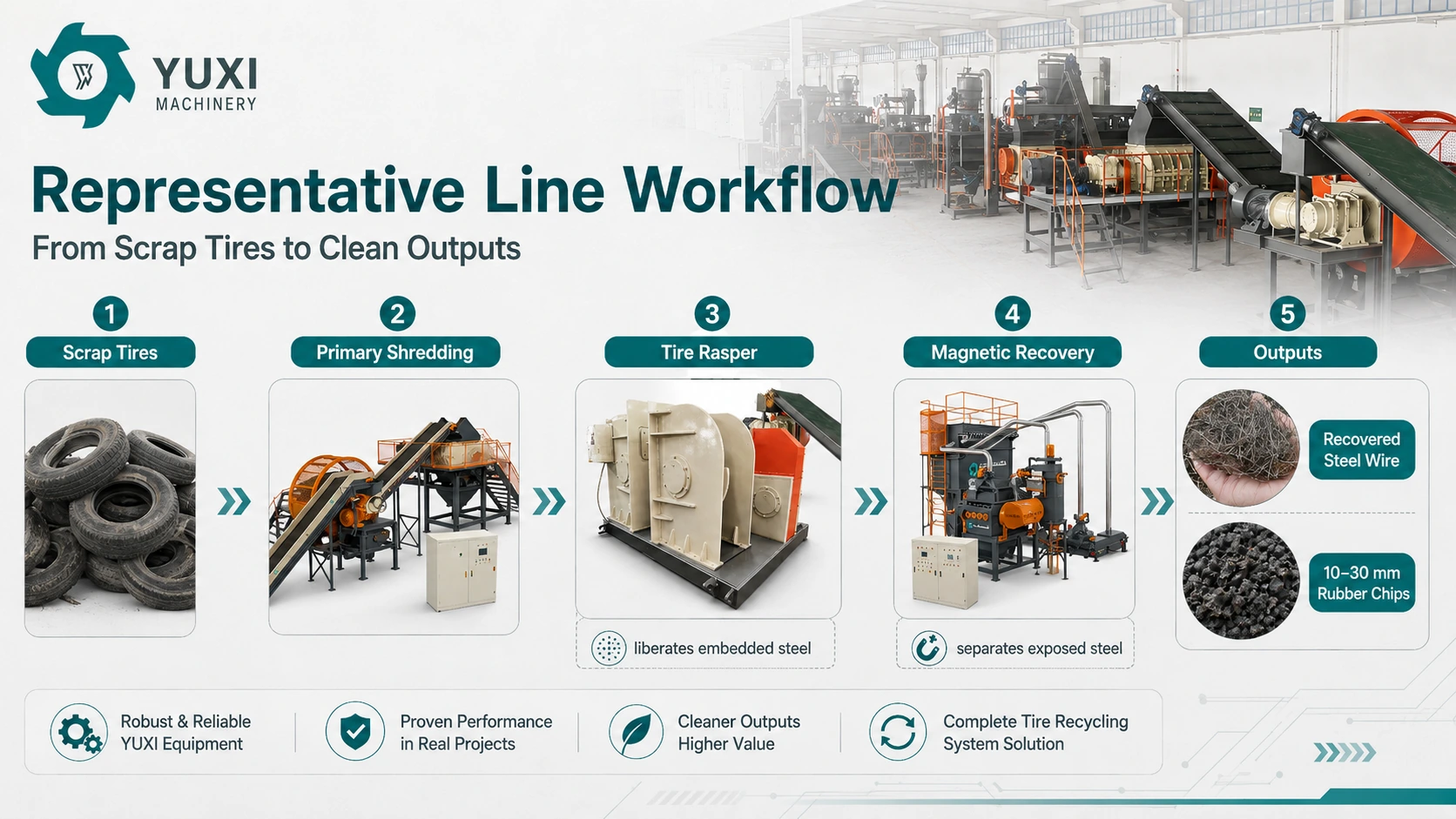
A tire rasper is a middle-stage machine that further reduces pre-shredded tire chips while breaking the rubber around embedded steel and exposing the wire for downstream magnetic recovery. Its job is not to finish the entire recycling process. It prepares the material for efficient steel recovery and, when required, for later granulation and fiber removal.
In a typical tire recycling route, the primary shredder handles whole or prepared tires and produces coarse chips. The tire rasper receives those chips, applies a more intensive cutting and tearing action, and improves steel liberation. A downstream magnetic separator then removes the liberated ferrous wire. The current YUXI tire wire steel separation system lists 10–30 mm rubber mulch and 500–15,000 kg/h for the complete system; these figures should not be treated as standalone rasper specifications without a model-specific test condition.
What Does a Tire Rasper Actually Do?
A tire rasper sits between coarse shredding and finer downstream processing. The primary shredder solves the first problem: turning a bulky tire into material that can be conveyed and metered. The rasper solves a different problem: reducing the chip further while breaking the mechanical bond between rubber and reinforcing steel.
This distinction matters because buyers sometimes compare a rasper with a tire shredder only by motor power or output size. That comparison misses the process role. A shredder is normally selected for whole-tire or coarse-chip reduction and robust feeding. A rasper is selected for secondary reduction, screen-controlled output and steel liberation before magnetic separation.
Industry suppliers describe this stage with slightly different names: tire rasper, tyre rasper, secondary rasper, steel liberation machine or tire liberator. The naming changes, but the engineering question is the same: can the machine receive the upstream chip size, open the rubber around the steel, control the discharge size and deliver a stable stream to the magnet?
How a Tire Rasper Works
Machine designs vary, so it is risky to describe every rasper as if it has the same rotor speed, knife geometry or power. The common operating logic is more useful.
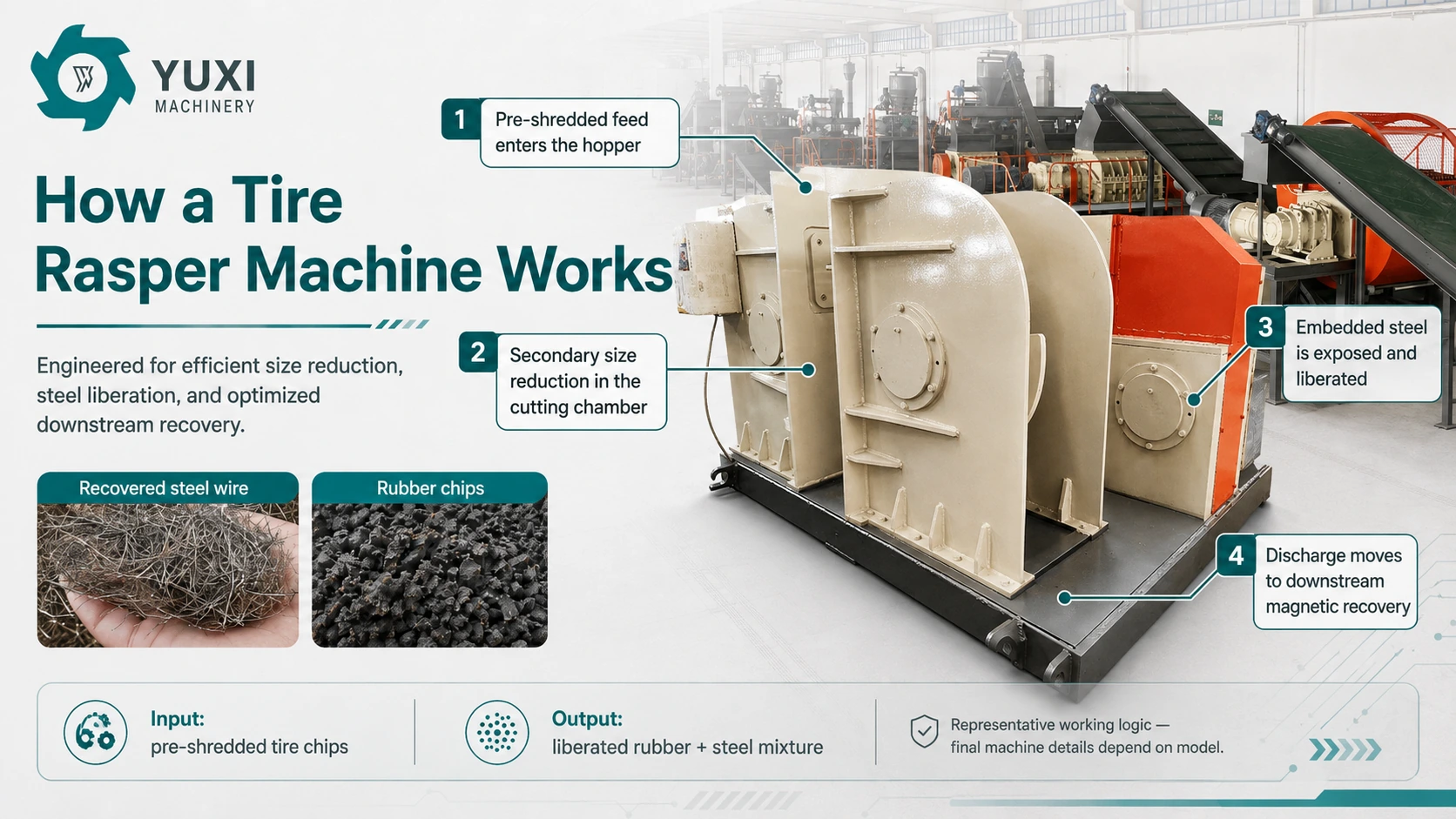
1Pre-shredded tire chips enter the cutting chamber
A rasper is normally not the first machine to receive an untreated whole tire. The feed has already been reduced by upstream equipment to a manageable chip size. Consistent feed matters because extremely large pieces, tangled bead sections or unexpected metal can create shock loading, poor chamber filling and unstable throughput.
2The rotor and stationary cutting elements work the chip repeatedly
The rotating cutting or rasping elements pull, cut and tear the rubber against stationary elements. Each pass reduces the rubber size and exposes more of the embedded steel cord. The objective is not simply “make it smaller.” The objective is to reach a size and liberation condition that allows downstream steel recovery to work reliably.
3A screen controls when material can leave
Many rasper designs use a screen around the cutting zone. Material that is still too large remains in the chamber and is processed again. Material small enough to pass the opening leaves the machine. For that reason, screen size influences more than nominal output size: it also affects residence time, recirculation, wear, heat generation and practical throughput.
4Rubber and steel leave as a liberated mixture
The rasper can expose and release a large share of the embedded steel, but the discharge is still a mixed material stream. The next magnetic separator performs the ferrous sorting. If the steel is still wrapped in thick rubber, the magnet may capture a wire-rubber bundle and take valuable rubber with it. If the wire is well liberated, recovery becomes cleaner and downstream rubber quality is easier to control.
Steel Liberation Is Not the Same as Steel Separation
This is the most important process boundary in this article.
| Process | Main purpose | Typical equipment | What a poor result looks like |
|---|---|---|---|
| Size reduction | Make tire pieces smaller and conveyable | Primary tire shredder | Oversized, inconsistent chips that overload the next stage |
| Steel liberation | Expose and release steel from the rubber structure | Tire rasper / liberator | Steel remains heavily coated or trapped in rubber |
| Steel separation | Physically remove liberated ferrous material from the rubber stream | Magnetic separator | Residual wire stays in rubber, or rubber is carried away with the wire |
| Fine size reduction / fiber control | Produce smaller granules and reduce textile contamination | Granulator + fiber separation | Granulator receives too much steel or oversized feed |
A magnetic separator can only recover ferrous material effectively when the steel is sufficiently exposed and properly presented to the magnetic field. Liberation quality, burden depth and material presentation all influence the final recovery result.
What Feed Size Should Enter a Tire Rasper?
There is no single universal inlet size for every rasper. Use the confirmed inlet range of the selected machine and validate it with representative pre-shredded material. Tire construction, chip thickness, steel content and feed consistency can all change the suitable operating window.
The correct feed condition depends on more than the longest dimension. A 70 mm loose passenger-tire chip and a dense truck-tire bead section of similar width do not behave the same way. Steel construction, chip thickness, residual bead wire, rubber hardness, temperature and how consistently the upstream shredder feeds the conveyor can all change the load.
Whole tires are normally the wrong feed
If the project needs to process whole passenger, truck or larger tires, the rasper should not be sized as if it were a primary whole-tire shredder. The line must first establish the correct upstream preparation route. Large OTR tires may require additional cutting or preprocessing before they can enter the same downstream equipment used for normal truck-tire chips.
Inconsistent feed reduces useful throughput
A machine may process individual oversize pieces, but that does not mean it will maintain the contracted tonnes per hour when the entire feed stream is oversized. High peaks cause current spikes and recirculation, while undersized fines can pass quickly and distort the apparent capacity. Capacity should therefore be tested with representative material, not a hand-picked batch.
What Output Size Can a Tire Rasper Produce?
At this stage, the rasper is normally used to produce a coarse, screen-controlled rubber stream before further processing. The exact standalone output must be confirmed against the selected screen, tire mix and recirculation arrangement rather than inferred from a complete-line figure.
If the downstream product is 1–5 mm crumb rubber or finer powder, the rasper is not the final size-reduction machine. The liberated rubber normally proceeds to the rubber granulation and fiber removal stage. Asking the rasper to do the granulator’s job can reduce throughput and increase wear without producing the controlled fine product the buyer actually needs.
Coarser screen / larger output
Usually means less recirculation and potentially higher throughput, but the steel may be less exposed if the material leaves too early.
Smaller screen / smaller output
Usually increases residence time and can improve size reduction, but may raise power demand, wear, heat and bottleneck risk.
Output size is not purity
Two lines can produce similar chip sizes but different residual-steel levels because liberation and magnetic recovery are different variables.
Downstream requirements decide the target
Mulch sales, crumb production and powder production need different process depths. Start with the product specification and work backward.
How Throughput Should Be Compared
One of the easiest ways to buy the wrong rasper is to compare catalogue tonnes per hour without checking the test condition. Throughput can change materially when the feed chip becomes larger, the screen becomes smaller, the tire mix contains more heavy truck material, the steel is harder to liberate, or the downstream conveyor and magnet cannot clear material fast enough.
| Capacity variable | Why it changes real throughput | What to ask the supplier |
|---|---|---|
| Feed chip size distribution | Oversize pieces need more cutting passes and may cause load peaks. | What inlet range was used for the published t/h? |
| Tire mix | Passenger, truck and special tires differ in rubber mass and steel reinforcement. | What percentage of each tire type was in the test? |
| Screen opening | Smaller apertures increase recirculation and residence time. | Which screen produced the quoted throughput? |
| Target steel liberation | Stopping earlier may increase t/h but leave more rubber attached to the wire. | How was liberation / residual steel checked? |
| Upstream feed stability | Surge feeding produces overloads while starved feeding lowers net output. | Was the test continuous and conveyor-fed? |
| Downstream magnet / conveyor | A rasper cannot sustain output if the next stage becomes the bottleneck. | Was capacity measured as a complete line or standalone machine? |
A useful acceptance test records net material processed over a defined stable run, the feed condition, screen, output sample, current or power behavior, stoppages and oversize recirculation. A single short video of the chamber running is not enough to prove sustained production.
How to Select a Tire Rasper for a Real Project
Start with the upstream material
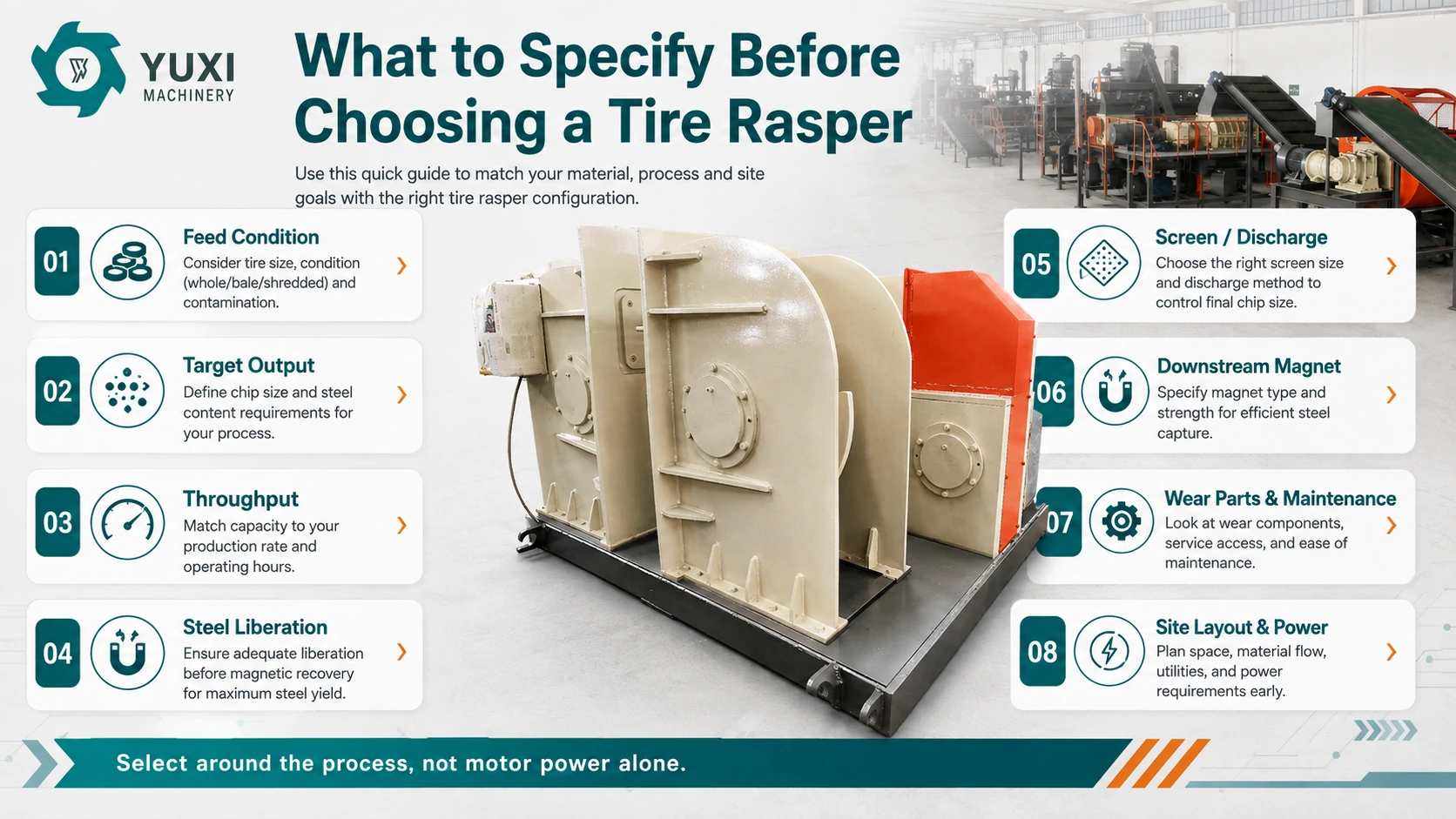
Send photographs and dimensions of the actual material leaving the primary shredder. State whether the feed is passenger tire, truck tire, mixed tire or pre-cut OTR material. If bead wire has been removed upstream, say so. If not, identify how much heavy bead section is expected in the rasper feed.
Define the product after the rasper
Do you want a coarse rubber mulch product, or is the rasper only preparing material for a granulator? This decision affects the screen and how aggressively the steel must be liberated before the next machine. The tighter the downstream requirement, the more important it becomes to define acceptable oversize and residual steel.
Specify net capacity, not installed motor power
Motor size helps define the machine drive, but it does not tell a buyer how many tonnes per hour the system will process under a particular feed and screen condition. Compare suppliers on the same feed, output and run duration. A larger motor attached to a poorly matched chamber or screen does not guarantee better production.
Match the magnet to the rasper discharge
Steel liberation only creates the opportunity for recovery. The conveyor and magnetic separator must handle the rasper discharge without excessive burden depth, spillage or rubber carryover. When the magnet is undersized, the buyer may incorrectly blame the rasper for residual steel. When liberation is poor, the opposite mistake happens: the buyer keeps increasing magnetic intensity even though the wire is still wrapped in rubber.
Plan for wear before the machine is installed
Tire steel is abrasive and mechanically demanding. Buyers should ask how cutting elements are inspected, turned or replaced; how the screen is accessed; how foreign objects are cleared; and how much maintenance space is required around the chamber. These details affect downtime more than a brochure photograph does.
Need to Match a Rasper to Your Tire Chips?
Prepare the tire type, chip-size range after primary shredding, required t/h, target output size, downstream product and local power supply. Those details allow the engineering team to compare a realistic configuration instead of selecting by motor size alone.
Common Problems and What Usually Causes Them
| Problem | Likely process causes | What to check first |
|---|---|---|
| Long steel wires remain embedded in rubber | Feed too large, insufficient cutting action, worn cutting elements, material leaving too early | Feed-size distribution, cutter condition, screen and discharge sample |
| Too much rubber leaves with recovered steel | Wire is only partly liberated or tangled into rubber bundles | Rasper discharge before the magnet; rubber still attached to the wire |
| Residual steel remains in rubber after the magnet | Poor liberation, thick conveyor burden, magnet position or capacity problem | Separate rasper performance from magnetic-separator performance |
| Throughput drops after fitting a smaller screen | Higher recirculation and longer residence time | Compare t/h at the same feed and target output condition |
| Frequent current peaks or stoppages | Oversized feed, heavy bead sections, unstable feeding, foreign metal or worn cutters | Inspect upstream material and log when peaks occur |
| Downstream granulator wears quickly | Too much steel or oversized rubber is reaching the fine-reduction stage | Check liberation, magnetic recovery and rasper output before the granulator |
When a Tire Rasper Is Not the Right Standalone Machine
A rasper is valuable when the project needs secondary tire reduction and steel liberation. It is not automatically the correct purchase for every tire recycling business.
- You only need coarse TDF/TDA chips: a primary shredding route may be enough if the buyer accepts the specified size and steel condition.
- You want fine crumb or powder from whole tires in one step: that product normally requires several stages. A rasper alone will not replace shredding, magnetic recovery, granulation, fiber separation and grinding.
- Your feed still contains rims or uncontrolled heavy metal: remove unsuitable items before the rasper. Do not treat overload protection as a substitute for feed preparation.
- Your project has no defined downstream product: first decide whether the business will sell coarse rubber, crumb, powder, recovered steel or an intermediate material. Machine selection should follow the sales specification.
Buyer Mistakes That Increase Cost Later
Buying by “tons per hour” alone
Throughput without feed and output conditions is not a comparable specification. Ask what tire mix, chip size and screen were used.
Assuming a smaller screen is always better
Smaller output may sound more valuable, but extra recirculation can reduce capacity and increase wear. If the next machine can accept a larger feed, over-processing in the rasper wastes energy and cutter life.
Using “99% separation” without defining the test
Separation claims are meaningless unless the denominator, sampling method and product stream are defined. A serious factory acceptance test should distinguish residual steel in rubber from rubber carried into the recovered steel fraction.
Ignoring line balance
The rasper, conveyor, magnet and downstream granulator form one material-flow system. Oversizing one machine does not increase plant output if the next stage is the bottleneck.
Skipping the wear-parts discussion
Ask which parts are consumable, how they are changed, what inspection interval is recommended and what spare set should be stocked. Maintenance access belongs in the buying decision, not only the service manual.
Rasper Performance Has to Be Verified as Part of the Line
A complete project makes the line-balance issue easier to evaluate. Upstream chip consistency, conveyor loading, steel liberation, magnetic recovery and downstream equipment all influence the useful throughput of the rasper stage. A high catalogue capacity on one machine does not guarantee the same net output from the complete recycling line.
For a published line-level example, see the 3T/H waste tire recycling machine project. The case shows why the purchasing discussion should cover the complete route from tire preparation through rubber, steel and fiber recovery rather than treating the rasper as an isolated component.
Information to Send Before Requesting a Rasper Quotation
- Tire types and approximate mix: passenger, truck, bus, special / OTR.
- Material condition entering the rasper: typical and maximum chip size, photos and whether bead wire is removed.
- Required net throughput in t/h and planned operating hours per shift.
- Target output size after the rasper and allowable oversize.
- Downstream product: coarse mulch, crumb rubber, powder or intermediate feed.
- Required steel cleanliness / residual-steel acceptance method, if already defined by your buyer.
- Local voltage, frequency and site electrical standard.
- Available floor space, conveyor arrangement and maintenance clearance.
- Whether the scope includes primary shredding, magnetic recovery, granulation, fiber separation or only the rasper stage.
Providing this information early usually removes more uncertainty than asking for “the biggest model” or “the most powerful motor.”
Tire Rasper FAQ
Can a tire rasper process whole tires directly?
Normally, a rasper is a secondary machine and receives pre-shredded tire chips. Whole tires are usually reduced by a primary shredder or suitable preprocessing equipment first. Final inlet limits must be confirmed for the selected model.
What is the difference between a tire shredder and a tire rasper?
A primary tire shredder handles bulky tires and produces coarse chips. A tire rasper further reduces those chips, controls output through a screen and improves steel liberation before magnetic recovery.
Does the tire rasper remove the steel wire?
It mainly liberates steel from rubber. The actual ferrous separation is normally performed by a downstream magnetic separator. Treating liberation and magnetic separation as the same process can lead to poor equipment selection.
What feed size is suitable for a tire rasper?
There is no universal size. Use the confirmed inlet range of the selected rasper and validate it with representative pre-shredded material. Tire construction, chip thickness, steel content and feed consistency can all change the suitable operating window.
What output size does a tire rasper make?
In YUXI’s complete tire wire steel separation system, the published rubber output is 10–30 mm. This is a complete-line result rather than a guaranteed standalone rasper specification. The actual rasper discharge depends on the selected screen, feed condition and process configuration. The exact result depends on the screen, feed and recirculation. If the project needs 1–5 mm crumb or fine powder, additional granulation and grinding stages are normally required.
Does a smaller screen always improve the project?
No. A smaller screen can increase residence time, recirculation, wear and energy demand while reducing throughput. The screen should be selected around the downstream product and the required steel liberation, not simply the smallest possible opening.
What should be included in a tire rasper acceptance test?
Use representative feed and record net tonnes processed over a defined stable run, the screen, output-size sample, steel-liberation condition, current or power behavior, stoppages and the downstream magnetic-recovery result. Agree the acceptance method before the test.
If you share the tire mix, chip size after primary shredding, required capacity and target rubber product, the next step is to check whether the rasper, screen, conveyor and magnetic separator are balanced as one process.