
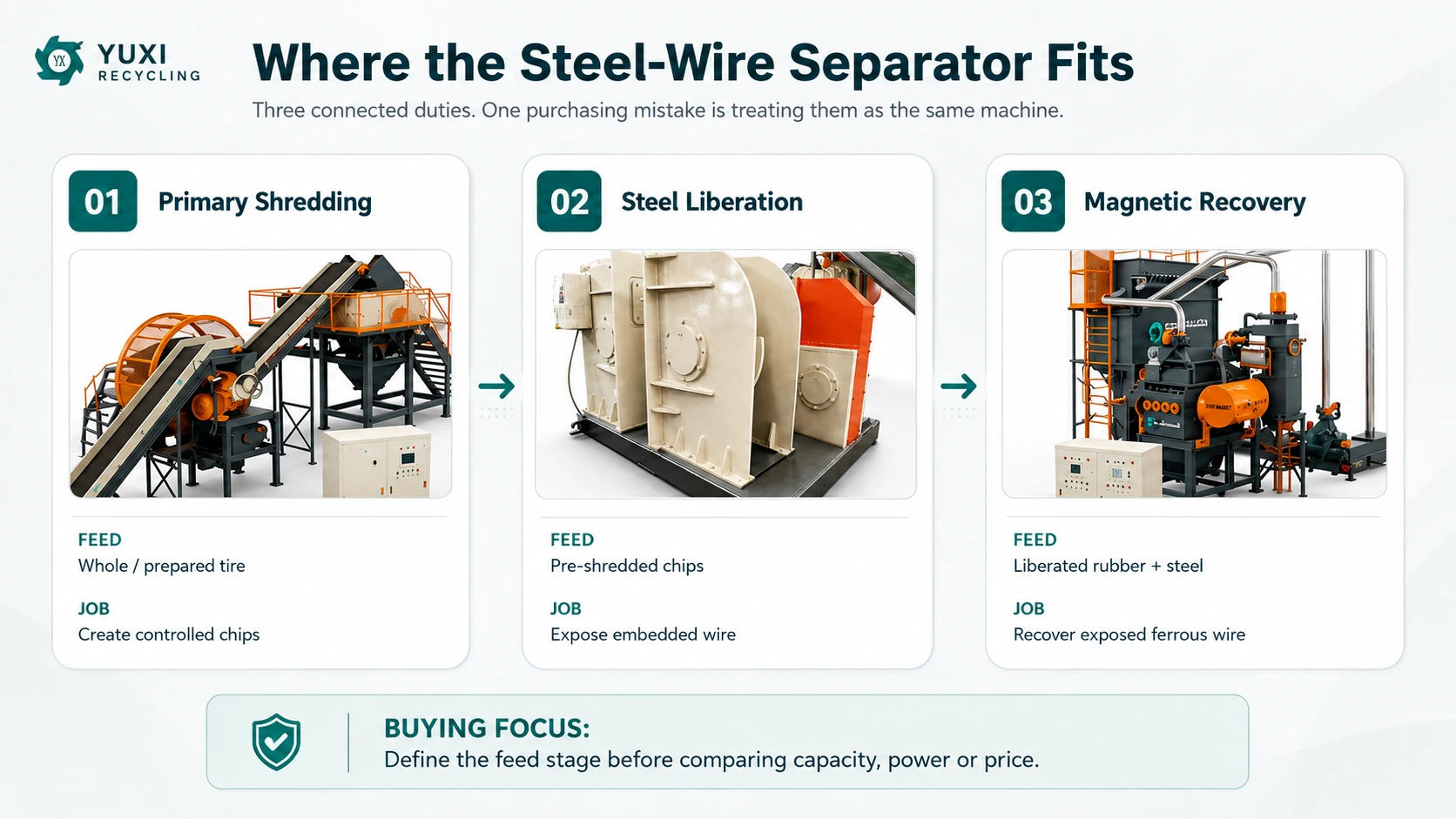
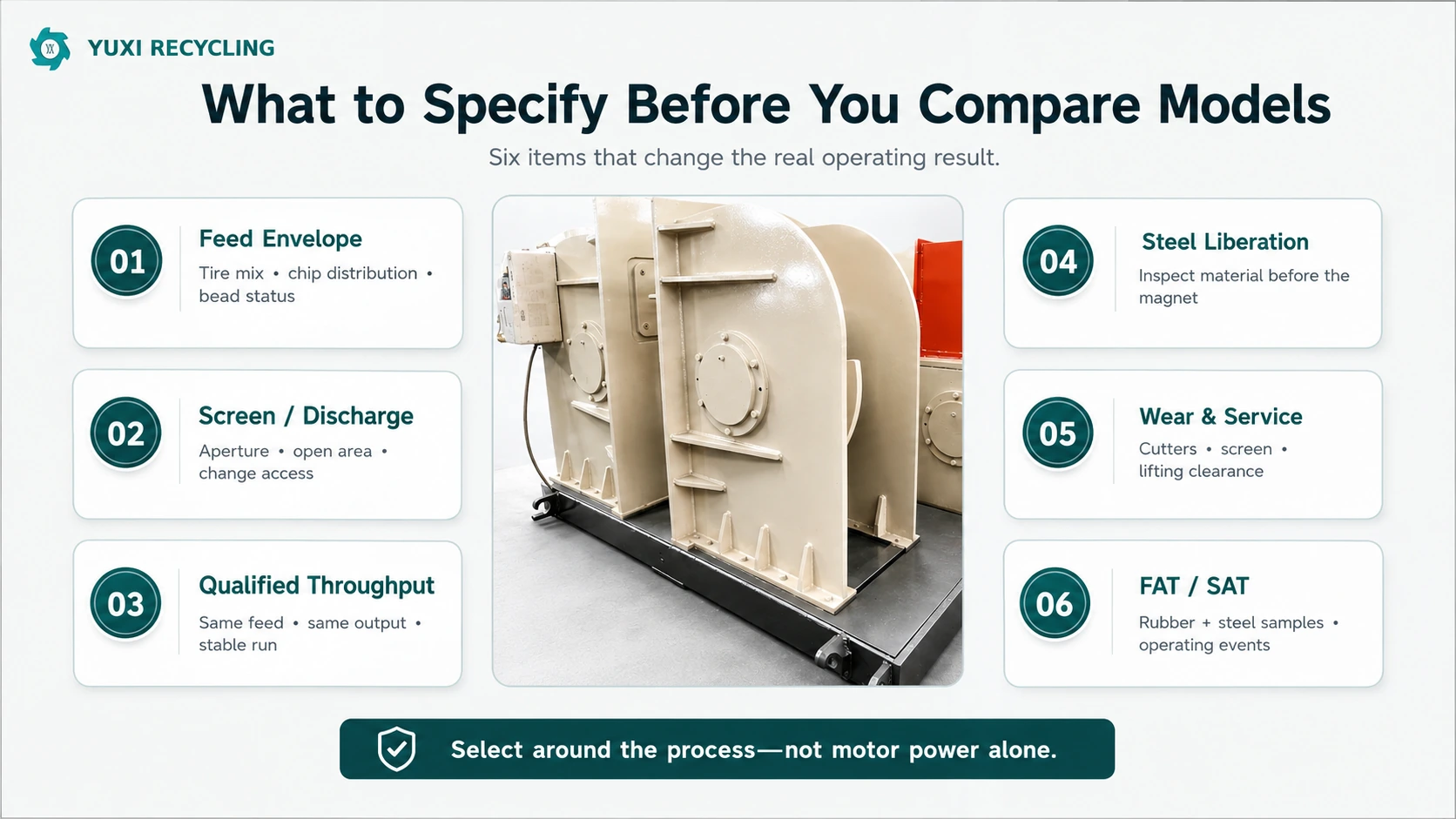
A tire steel wire separator should be selected from the material it must process, not from the machine name or motor power. The same search term is used for equipment that handles bead rings, pre-shredded tire chips, and already-liberated steel. Those are different jobs. For a procurement team, the useful sequence is: identify the process stage, define the feed envelope, set measurable rubber and steel outputs, normalize throughput, check screen and wear access, confirm the interface with the magnet, and write the acceptance test before the purchase order is issued.
YUXI’s tire wire steel separation system uses a tire shredder and tire rasper as its main machines. The complete line lists 10–30 mm rubber mulch, recovered wire steel and 500–15,000 kg/h capacity. These are system-level figures. They should not be copied into a standalone separator specification unless the selected machine, feed condition, screen/discharge setting and test basis are confirmed. A serious separator RFQ should define the feed, output quality, qualified throughput, wear/service requirements and FAT/SAT method.
First Decide Which Steel-Wire Job You Are Buying
The phrase tire steel wire separator is ambiguous in the current market. Before comparing quotations, identify what the material looks like when it reaches the machine. If two suppliers are talking about different feed stages, their capacity, power and price numbers are not comparable.
| Equipment class | Actual feed | Main job | Use it when… |
|---|---|---|---|
| Bead-wire extraction machine | Prepared tire bead / bead ring | Pull or separate the heavy bead wire before later shredding | Your material is still a bead section rather than shredded chips |
| Chip-stage tire steel wire separator / rasper | Pre-shredded rubber chips containing belt/cord steel | Further reduce rubber and liberate embedded steel | You need cleaner rubber before magnetic recovery or later granulation |
| Magnetic steel-recovery stage | Rubber-steel mixture with sufficiently exposed ferrous wire | Physically recover exposed steel from the rubber stream | Liberation is already adequate and the remaining task is ferrous sorting |
If the feed is a prepared bead ring, compare a dedicated tire wire drawing machine. If it is already shredded tire chips, a bead-wire machine solves the wrong problem. This distinction sounds basic, but it prevents one of the most expensive RFQ errors: purchasing a machine because its English name matches the keyword while its process duty does not match the material.
Build a Feed Envelope Instead of Quoting One Maximum Size
There is no universal feed-size number for every tire steel wire separator. A better specification is a feed envelope: the material condition expected during normal production plus the recurring oversize and credible abnormal pieces. This gives the supplier enough information to size the chamber, cutting system, screen, protection and upstream feed control.
Tire mix and construction
State whether the plant processes passenger tires, truck and bus tires, a mixed PCR/TBR stream, or pre-cut larger tires. The important point is not the label itself; it is that tire construction changes steel loading, chip stiffness and the force needed to break rubber away from the reinforcement.
Chip-size distribution
The upstream tire shredder produces a distribution, not one exact dimension. Record what most chips look like, the recurring oversize and how often heavy sections appear. If 90% of the material is easy but the remaining 10% repeatedly creates overloads, that minority can determine the practical separator size.
Bead-wire status
Write down whether bead wire is removed before shredding, partially removed, or normally remains. Thick bead sections behave differently from flexible belt wire. If the supplier assumes the bead is removed but your line sends it downstream, the quotation can be undersized even when the nominal chip dimensions look correct.
Bulk behavior
When possible, weigh a known-volume container filled with representative chips. The simple mass ÷ volume result gives a field estimate of bulk density. It is not a laboratory property, but it helps explain why two chip streams with similar dimensions can create different conveyor loading and hourly mass flow.
Contamination and abnormal feed
List realistic foreign material: remaining rims, stones, chains, tools, road debris or other metal. Do not use overload protection as permission to feed uncontrolled scrap. Protection logic limits damage from abnormal events; it does not make every contaminant acceptable.
| Feed item | What to provide | Why it changes selection |
|---|---|---|
| Tire mix | Approximate passenger / truck / other percentage | Changes steel reinforcement and mechanical load |
| Normal chip distribution | Photos plus simple size grouping | Defines the main process load |
| Recurring oversize | Largest common difficult pieces | Shows peak chamber/cutter demand |
| Bead status | Removed / partly removed / normally present | Changes shock load and wear exposure |
| Bulk-density estimate | Mass from a known-volume container | Helps compare volumetric and mass throughput |
| Foreign-object risk | Credible contaminants, not hypothetical extremes | Defines protection and operating procedure |
Specify the Rubber and Steel Outputs Before You Select a Screen
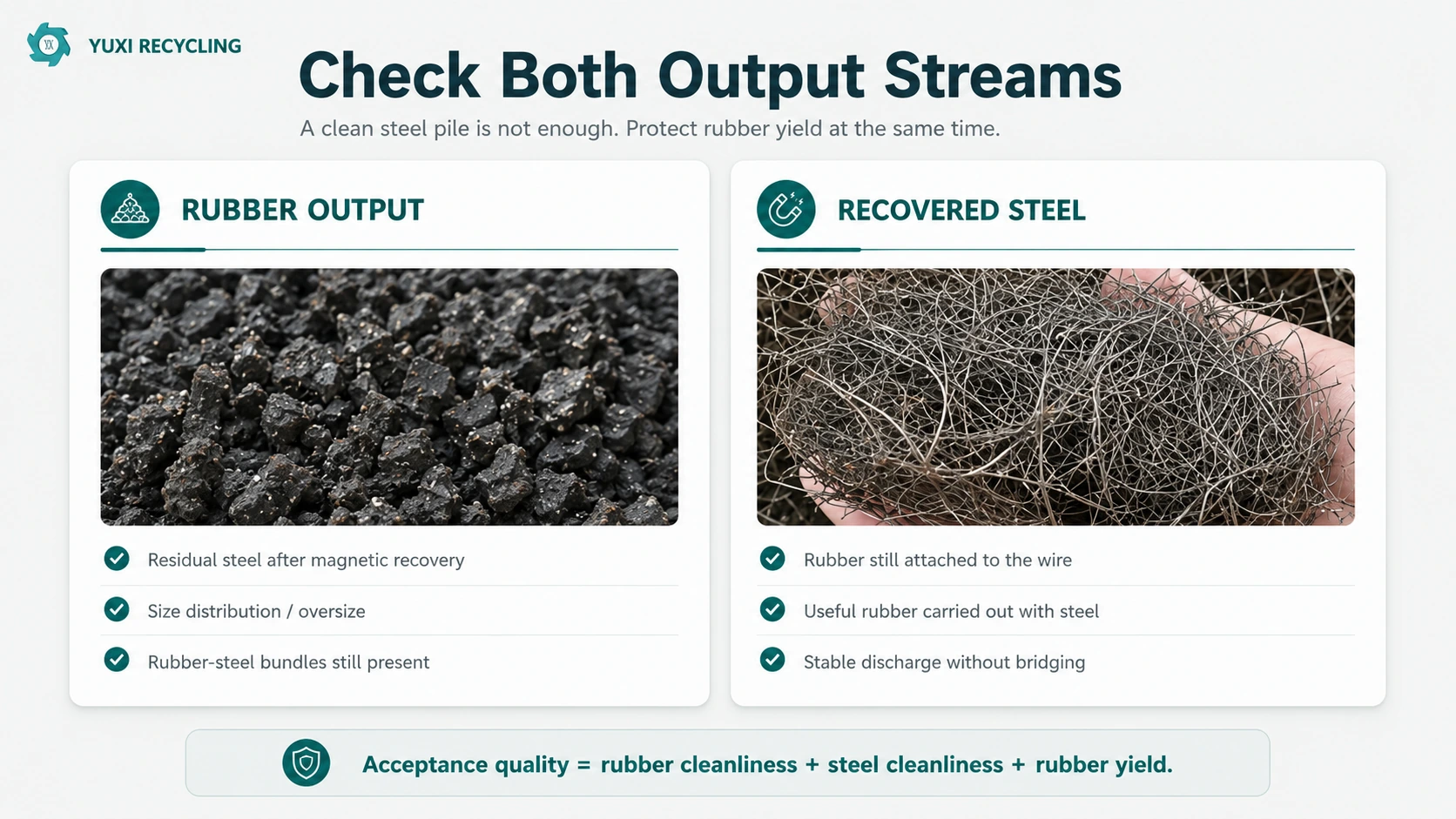
A buyer often starts with “I need 20 mm” or “I need 5 t/h.” Neither number is enough. A separator is useful only if the rubber size, residual steel, rubber yield and downstream process all remain acceptable together.
Write three output requirements into the RFQ:
- Rubber discharge: target size condition and how oversize / recirculation is handled.
- Residual steel in rubber: the agreed sample method after the magnetic-recovery stage.
- Rubber carryover with recovered steel: how much useful rubber is leaving with the ferrous fraction.
These outputs interact. A smaller screen may increase steel exposure but also increases internal recirculation. A magnet can capture a rubber-steel bundle and make the recovered-steel pile look impressive while reducing rubber yield. Higher feed rate can shorten effective residence time or overload the downstream conveyor. The purchase specification should therefore describe an acceptable operating window, not one isolated target.
Steel Liberation Is the Core Performance Variable
For a chip-stage tire steel wire separator, the central process result is liberation: removing enough rubber from the embedded steel so that the downstream magnetic stage can recover the wire efficiently. The tire rasper working principle explains the mechanism in more detail; the buying decision here is how to recognize whether the separator is doing that job well.
Inspect the material immediately before the magnet. If long wires are still wrapped in thick rubber, the cutting/rasping stage is not liberating enough. If the wire is visibly exposed but remains in the rubber after magnetic recovery, the problem has moved downstream to material presentation, burden depth, magnet position or steel discharge.
What to ask about the rotor and cutting system
Without inventing a universal design, ask the supplier to show the rotor arrangement, moving and fixed cutting elements, how clearances are adjusted, which elements are individually replaceable, and how the cutting zone interacts with the screen. A drawing or chamber photo is more useful than a sentence saying “wear-resistant blades.”
What to inspect in a test sample
Look for the form of the remaining steel, not only a purity percentage. Free wire, thin rubber-coated wire, and large rubber-steel bundles point to different adjustments. Keep a few representative samples from the FAT; they become useful references during commissioning and later troubleshooting.
Screen Aperture Is Only One Part of Screen Selection
Official tire-liberation equipment from established manufacturers commonly uses screen-controlled discharge. The principle is straightforward: material that cannot pass remains in the chamber for more cutting. The engineering detail is that aperture, total open area, screen strength and service access all influence the result.
| Screen variable | Likely process effect | Buyer question |
|---|---|---|
| Smaller opening | Longer residence, more recirculation, potentially more liberation | What happens to qualified t/h, current load and wear? |
| Larger opening | Faster discharge | Does the wire remain sufficiently exposed for recovery? |
| Total open area | Can restrict discharge even with the same nominal aperture | What is the effective open area of the installed screen? |
| Screen strength / construction | Must tolerate impact while maintaining the intended opening | How is wear or deformation inspected? |
| Screen-change access | Changes downtime when the product size or screen condition changes | Show the actual removal path, lifting method and safe access |
When a supplier quotes capacity, record the exact screen/discharge condition used. If the number changes dramatically when you ask for a smaller output, that is not necessarily a defect; it is evidence that the process is doing more internal work. The important question is whether the smaller output is actually needed for the next stage.
Normalize Throughput Before Comparing Two Models
Installed kW and headline t/h are easy to compare and therefore easy to misuse. Use qualified throughput instead: representative feed processed per hour while the agreed rubber and steel outputs remain within the acceptance condition.
For an apples-to-apples comparison, Supplier A and Supplier B should be evaluated against the same feed description, screen/discharge target, recirculation basis and output-quality method. Otherwise the higher t/h number may simply describe an easier test.
| Normalize this | Record during comparison | Reason |
|---|---|---|
| Feed | Tire mix, chip distribution, bead status | Mechanical load changes with material |
| Discharge | Screen / output condition | Smaller output usually requires more internal work |
| Recirculation | Internal or external oversize return | Prevents hidden load from disappearing from the capacity claim |
| Stable operating window | Continuous test period after the chamber is normally loaded | Avoids using a short burst as rated production |
| Output quality | Rubber residual steel + steel-stream rubber carryover | High t/h is useless if quality collapses |
Add two operating-cost metrics if data is available
Energy per qualified ton can be calculated from measured kWh divided by qualified tonnes during the same test basis. Wear-parts cost per qualified ton can be tracked over a longer production period from actual consumed wear parts divided by qualified tonnes processed. These metrics are more useful than comparing motor ratings or spare-part prices in isolation.
Match the Separator, Conveyor and Magnet as One Material-Flow Stage
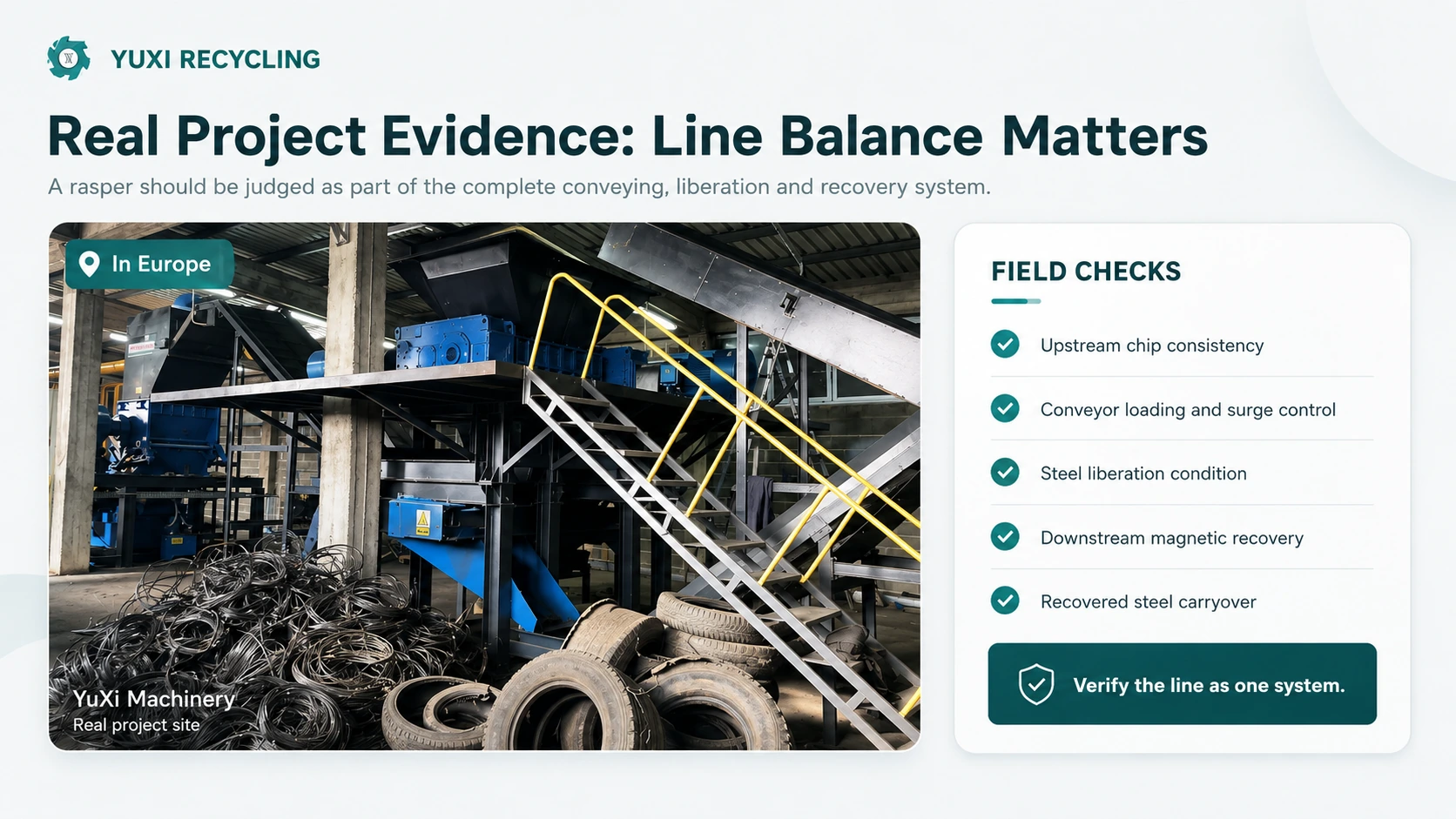
The separator may liberate steel correctly and still deliver poor final recovery if the downstream interface is wrong. The rubber-steel mixture must leave the chamber, spread across the conveyor and reach the magnetic zone without excessive surging or a material layer so deep that exposed wire is buried.
Keep this article at the interface level rather than redesigning the magnet. For the separator RFQ, confirm the discharge height, conveyor width, expected loading, space reserved for the magnet, and how recovered wire leaves the magnetic zone. Long flexible steel can bridge or wrap if chutes and discharge paths are treated as an afterthought.
A field troubleshooting shortcut
Take one sample before the magnet and one after it. If the first sample contains rubber-steel bundles, work upstream. If the steel is already free in the first sample but appears again in the rubber output, work on the magnetic-recovery interface. This simple split prevents random adjustments across the whole line.
Keep Final Granulation Out of the Separator Specification
A chip-stage separator prepares rubber for the next process. If the commercial product is coarse mulch, steel liberation may be close to the final sizing step. If the target is fine granule or powder, further reduction is a different duty.
After the major steel is removed, rubber can continue to a rubber granulation and fiber removal system. This protects the fine-processing equipment and lets each machine work in its intended range. Forcing the separator to make unnecessarily fine material can increase recirculation and wear without creating value at that stage.
| Target product | Separator-stage objective | Likely next step |
|---|---|---|
| Coarse mulch | Controlled rubber size + major steel liberation/recovery | Screening or product polishing as required |
| Fine granules | Prepare cleaner feed with major steel removed | Granulation + fiber removal |
| Rubber powder | Protect fine processing by removing bulk steel early | Granulation, fiber removal and grinding |
Maintenance Access Can Change Monthly Output More Than Nameplate Capacity
Steel-reinforced tire chips are a wear application. The question is not whether parts wear; it is whether wear is predictable, parts are accessible, and the plant can return to production without unnecessary downtime.
Ask for a wear-parts schedule that names the actual consumables: moving/fixed cutting elements, screens, liners, scrapers, conveyor wear items and any critical bearings or seals that require planned inspection. The supplier should also identify which parts are normally stocked with the machine and which have longer lead times.
Walk the maintenance path on the drawing
Check how the chamber opens, where a screen exits, how a heavy cutter is lifted, whether a crane or forklift can reach the service point, and whether the platform gives a technician enough working room. A machine can be easy to maintain in a factory photo and difficult to maintain after another conveyor is installed 300 mm away.
Track wear by production, not calendar days
“Change every three months” means little if one plant runs one shift and another runs continuously. Record inspection condition together with qualified tonnes processed. Over time, that creates a plant-specific wear baseline that is far more useful than a generic service interval.
Review Controls, Interlocks and Site Interfaces Before Layout Approval
Line automation should keep the separator inside a stable operating window. If the upstream shredder releases large surges and then starves the separator, both liberation and downstream recovery can become inconsistent. The control philosophy should therefore connect upstream feed, separator load and downstream availability.
- Drive information: main and auxiliary installed loads for the quoted scope.
- Overload response: alarm, stop, reverse or other model-specific logic.
- Interlocks: what happens if the downstream conveyor or magnet stops?
- Restart sequence: how stored material is cleared without creating a second surge.
- Guard/access switches: confirm isolation before chamber or screen service.
- Service clearance: show dimensions on the GA drawing, not only in a manual.
- Site power: voltage, frequency and available electrical capacity.
- Housekeeping: define rubber fines, dust and wire accumulation points that need cleaning access.
Compare Quotations With the Same Scope, Not the Same Machine Name
Two quotations can both say “tire steel wire separator” while one includes a magnet, platforms and conveyors and the other includes only the liberation machine. Build a comparison sheet before judging price or capacity.
| Comparison field | Supplier A | Supplier B | Required clarification |
|---|---|---|---|
| Feed basis | Same tire/chip condition? | ||
| Screen / discharge basis | Same output target? | ||
| Qualified throughput | Same stable-test definition? | ||
| Magnet included? | Type/scope or excluded? | ||
| Conveyors included? | Width, length, drive and support? | ||
| Electrical / controls | Cabinet, interlocks, field wiring scope? | ||
| Platforms / stairs | Included or customer supply? | ||
| Wear / opening spares | Part numbers and quantities? | ||
| FAT / commissioning | Test material, duration, travel/site scope? | ||
| Exclusions | List them explicitly |
Quotation red flags
- A model is recommended without requesting a representative feed photo.
- Capacity is quoted without stating feed and screen/discharge conditions.
- The supplier cannot clearly separate bead-wire extraction from chip-stage liberation.
- A purity or “separation rate” is promised with no sampling method.
- No drawing shows the screen/cutter service path.
- Magnet and conveyor scope is described vaguely.
- The proposal has no list of exclusions.
- The supplier refuses or avoids a representative-feed test when testing is practical.
Use Project Scenarios to Check Whether the Proposed Machine Fits
Bead-ring preprocessing only
If your material is a prepared bead ring, the chip-stage separator is the wrong first comparison. Focus on bead-wire extraction before later shredding.
Coarse rubber mulch line
Focus on stable chip-stage liberation, screen/discharge control, bulk steel recovery and rubber yield. The separator may be close to the final sizing stage.
Fine granule or powder line
Use the separator to remove major steel and prepare cleaner feed. Let downstream granulation, fiber removal and grinding handle the fine-product duty.
Retrofit with residual steel problem
Sample before and after the magnet first. Do not buy another separator until you know whether the root cause is poor liberation or poor recovery.
Project Evidence: Judge the Separator Inside the Complete Line
The 3T/H waste tire recycling machine is useful as a first-party line reference. It shows the practical point behind this guide: shredding, conveying, steel liberation, magnetic recovery and downstream processing share the same material flow. A change in one stage can move the bottleneck elsewhere. The case should not be used to invent a standalone separator setting; it is evidence that the separator must be evaluated as part of the whole route.
Write the FAT and SAT Before You Issue the Purchase Order
A factory acceptance test should verify the agreed process result, not only whether the motor starts. The test basis belongs in the technical agreement before the equipment is built. That prevents arguments later about an undefined “rated capacity” or “99% separation.”
FAT: establish the baseline
Use representative feed and record the exact screen/discharge condition. After the machine reaches a normal loaded state, run an agreed stable window and record feed mass, qualified throughput, recirculation, motor/current behavior, trips/reversals and manual intervention. Take multiple rubber and steel samples across the run rather than choosing one attractive sample at the end.
| FAT item | What to record | What it proves |
|---|---|---|
| Representative feed | Tire mix, chip distribution, bead condition | The test material matches the purchase basis |
| Stable throughput | Feed mass / time under normal loaded operation | Useful continuous capacity |
| Screen / discharge | Installed screen and oversize handling | Capacity and output refer to the same condition |
| Rubber samples | Size condition + residual ferrous material | What the stage failed to liberate/recover |
| Steel samples | Rubber still attached or carried with wire | Steel cleanliness and rubber-yield loss |
| Operating events | Current peaks, jams, reversals, stops | Whether the rated run is sustainable |
| Maintenance demo | Open chamber / show screen and cutter access | The service plan is physically practical |
SAT: confirm the installed system
After installation, repeat the critical product and throughput checks with the real conveyors, magnet, electrical supply and site layout. Also verify belt tracking, chute discharge, interlocks, access clearance and material accumulation points. A factory test cannot prove an installation that did not yet exist.
Use a Root-Cause Matrix When the Test Misses the Target
| Observed symptom | First evidence to inspect | Likely direction |
|---|---|---|
| Steel remains wrapped in thick rubber | Material before the magnet; cutter/screen condition | Improve liberation / residence condition |
| Steel is exposed before magnet but remains in rubber after it | Conveyor loading, material layer, magnet interface | Improve recovery stage presentation |
| Large rubber pieces leave with recovered steel | Recovered-steel sample | Improve liberation before increasing magnetic capture |
| Throughput falls after changing to smaller output | Recirculation, current, screen condition | Confirm whether smaller discharge is worth the extra internal work |
| Repeated current spikes or reversals | Oversize, bead sections, feed surges, cutter condition | Stabilize feed / inspect wear and load |
| Good output at low feed, poor quality at target rate | Burden depth, conveyor loading, downstream capacity | Rebalance the complete stage |
Change one variable at a time where practical and keep the feed as consistent as possible during the comparison. Randomly changing screen, feed rate and magnet position together can make the next test better without revealing why.
RFQ Data Sheet for a Reliable Separator Recommendation
The final RFQ should read like a process specification, not “please quote 5 t/h tire wire separator.” The following information gives an engineer enough context to make a defensible recommendation.
- Tire types and estimated percentage mix.
- Photo/video of the actual separator feed.
- Normal chip-size distribution and recurring oversize.
- Bead-wire status before primary shredding.
- Bulk-density field estimate if available.
- Required qualified throughput.
- Target rubber discharge condition.
- Residual-steel sampling / acceptance method.
- Recovered-steel cleanliness or rubber-loss target.
- Existing/proposed conveyor width and discharge height.
- Whether magnetic recovery is included in supplier scope.
- Downstream product: mulch, granule, crumb or powder.
- Voltage, frequency and available site power.
- Floor area, ceiling height and service/lifting clearance.
- Dust/housekeeping/fire-control interfaces for the line.
- Required opening spare-parts package.
- FAT test material and acceptance scope.
- SAT / installation / commissioning responsibility.
Share the tire mix, separator-feed photos, chip distribution, bead status, required qualified throughput, target rubber output and downstream process. The separator should be configured around the real material-flow requirement, then verified with a written acceptance method.
Tire Steel Wire Separator FAQ
Is a tire steel wire separator the same as a tire wire drawing machine?
No. A tire wire drawing machine processes prepared bead sections and extracts the heavy bead wire upstream. A chip-stage tire steel wire separator processes pre-shredded tire chips and helps liberate embedded belt/cord steel before magnetic recovery.
What feed size should a tire steel wire separator receive?
There is no universal feed size for every model. Provide the normal chip-size distribution, recurring oversize, tire construction and bead-wire condition, then confirm the acceptable inlet envelope for the selected machine.
Does a smaller screen always improve steel separation?
No. A smaller screen can increase residence time and steel liberation, but it can also increase recirculation, power load, heat and wear while reducing qualified throughput. The screen should be selected for the required downstream process.
Does a bigger motor mean a higher separator capacity?
No. Qualified throughput also depends on feed condition, cutting/chamber design, screen setting, wear condition, recirculation, conveyor loading and downstream recovery. Compare t/h only under equivalent test conditions.
How can I tell whether poor steel removal is caused by liberation or the magnet?
Inspect material immediately before magnetic recovery. Steel still wrapped in thick rubber points upstream to liberation. Exposed steel that remains in the rubber after the magnet points to the recovery interface.
Can one tire steel wire separator produce final crumb rubber?
Usually it is a mid-stage machine. Fine granules or powder normally require later granulation, fiber removal and possibly grinding after major steel recovery.
How should separator efficiency be tested?
Define the sampling method before the test. Check residual ferrous material in the rubber stream and rubber carryover in the recovered-steel stream while recording feed condition, throughput, screen setting, recirculation and operating events.
What maintenance information should be requested before purchase?
Request the normal wear-parts list, quantity per change, service-access method, lifting requirements, inspection criteria, opening spares and lead time for critical components.
What information should I send for model selection?
Send tire type, feed photos, chip-size distribution, bead-wire status, target qualified throughput, target rubber output, acceptance method, downstream process, site layout and electrical supply.