
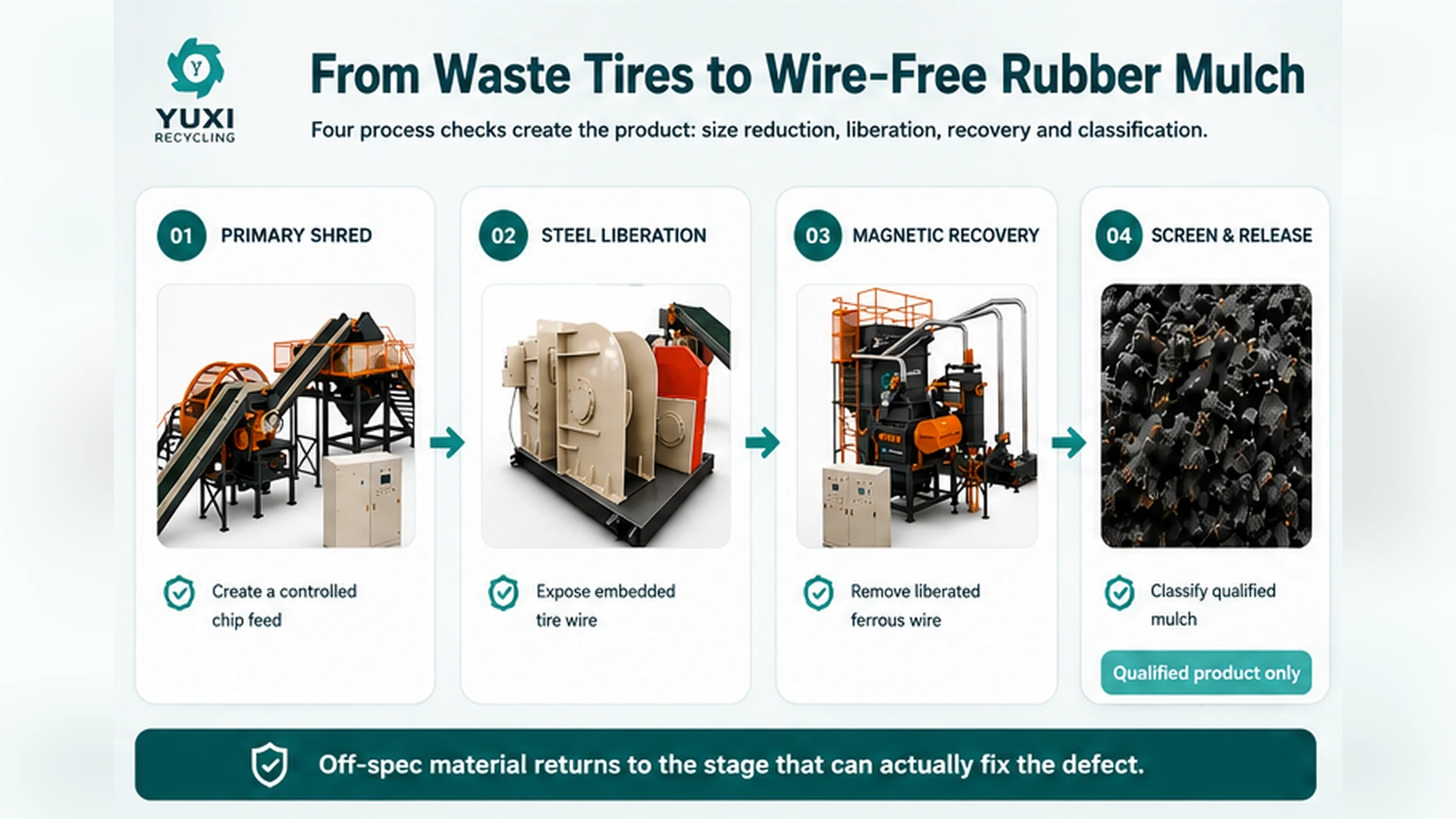
Industrial wire-free rubber mulch is not simply “small tire pieces with most of the wire gone.” A stable product has to meet a defined size range, residual-steel condition and acceptable rubber yield over a real production run. The rubber mulch production process therefore has to control the material at every stage: create consistent primary shreds, liberate embedded steel, recover the free wire, screen the rubber into qualified fractions, and route off-spec material back to the correct process instead of blending it into finished product.
Define the Finished Mulch Before the Tires Enter the Line
The term wire-free rubber mulch is widely used for rubber chips that have been processed to remove tire steel, but it is not a complete acceptance specification by itself. A landscaping customer, a low-steel TDF buyer and a plant that will granulate the material further can all require different chip sizes and impurity conditions.
Start with the product, not the equipment list. Write down the accepted size fraction, the residual-steel rule, whether visible textile is acceptable, and whether the mulch will be released as a finished product or continue to finer processing.
YUXI’s tire wire steel separation system lists 10–30 mm rubber mulch and wire steel as complete-system outputs and 500–15,000 kg/h as the complete-system capacity range. Those figures are useful as the current YUXI line-level reference, but they should not be copied into a standalone shredder, rasper or magnetic separator specification.
| Product item | Define before production | Why it matters |
|---|---|---|
| Mulch size | Accepted fraction + oversize/undersize rule | Controls product screening, rework and qualified yield |
| Residual steel | Allowed condition + sample/test method | Defines when magnetic recovery is good enough |
| Visible fiber | Buyer-specific acceptance | Wire-free and fiber-free are different requirements |
| Recovered steel | Acceptable rubber carryover | Prevents qualified rubber from leaving with the wire |
| Final destination | Release as mulch or continue to crumb production | Prevents over-processing or under-processing |
Build the Process in Stages: Whole Tire → Controlled Chip → Liberated Steel
The first stage creates feed for the mulch line; it does not normally create the final mulch. The YUXI tire shredder uses dual-shaft shearing with disc-screen return of unqualified material. In practical terms, that means the next stage should receive a more controlled stream instead of a mix of small pieces and recurring oversize tire sections.
Feed consistency matters because secondary steel liberation is sensitive to what enters the chamber. A mixed PCR/TBR stream, bead-heavy pieces, large recurring oversize and sudden conveyor surges can all change the process load even when the average hourly feed looks unchanged.
Operators should record the dominant tire mix and unusual material at the start of a production lot. If bead-wire preprocessing is used, record that too. The goal is not laboratory precision; it is to explain why identical machine settings may produce different results on different feed lots.
The next stage is where tire chips become mulch-sized material and the steel is exposed. The tire rasper working principle uses repeated cutting and tearing with screen-controlled discharge to reduce the rubber while liberating embedded steel. Two outputs are being created at the same time: a smaller rubber fraction and steel that can move independently enough to be recovered.
The central tradeoff is straightforward. A discharge condition that is too coarse for the target mulch may leave rubber-steel composites. Forcing unnecessarily fine output can increase internal recirculation, wear and energy use. The useful endpoint is the coarsest condition that still produces the required mulch size and sufficient steel liberation for reliable downstream recovery.
Magnetic Recovery Only Works on Steel That Can Move
After secondary reduction, the stream contains rubber chips, liberated wire, partly liberated composites and possibly textile. The magnetic stage removes ferrous steel that has been exposed enough to change trajectory away from the rubber.
The detailed capture mechanics are covered in the magnetic separator for tire recycling article. For mulch production, the faster field check is to compare material immediately before the magnet with the rubber and steel leaving the stage.
If thick rubber is still wrapped around the steel before magnetic recovery, the upstream liberation stage is limiting. If the wire is already free before the magnet but appears in the finished rubber, then material presentation or magnetic recovery needs attention. If the steel discharge contains large rubber chunks, the metal may be recovered while rubber yield is being lost.
Screening Turns Processed Rubber Into a Defined Product
Screening after size reduction and steel recovery is one of the most under-explained parts of wire-free rubber mulch production. Industrial processors use it not only to improve appearance, but to decide what can be released as product and what must be reworked.
There are two screening jobs to keep separate. A process screen inside a size-reduction machine controls when material leaves that machine. A product screen classifies the output into commercial size fractions. They influence different parts of the process even though both are casually called “screening.”
- Qualified mulch moves to storage, packing or the next customer step.
- Oversize returns to the stage responsible for additional size reduction.
- Undersize/fines may become another product or feed to crumb processing.
- Rubber-steel composites should be reworked instead of hidden in the qualified pile.
Feed throughput is therefore not the same as qualified-product throughput. If a large fraction continually returns as oversize or rework, the commercial output is lower than the feed meter suggests. A useful operating trend is qualified mulch output per hour under the current product specification.
“Wire-Free” Needs a Sampling Rule—and the Steel Stream Needs One Too
Industry pages often advertise very high steel-free percentages. Those numbers cannot be compared unless the sampling basis is known. A meaningful production check needs a sample location, representative sample mass, production lot or time window, and a rule for how residual steel is counted or weighed.
The exact method should be agreed with the buyer or the plant’s internal quality plan. At minimum, record:
- sample location and sample mass;
- production lot / time window;
- screened size fraction;
- free wire found;
- rubber-coated wire or composite pieces found;
- visible fiber if the buyer limits it.
If a buyer specifies a mass-based metal limit, separate and weigh the residual ferrous material from the defined rubber sample using the agreed method. If the buyer uses a visual or count-based defect rule, record that instead. Use the same method for release decisions and troubleshooting.
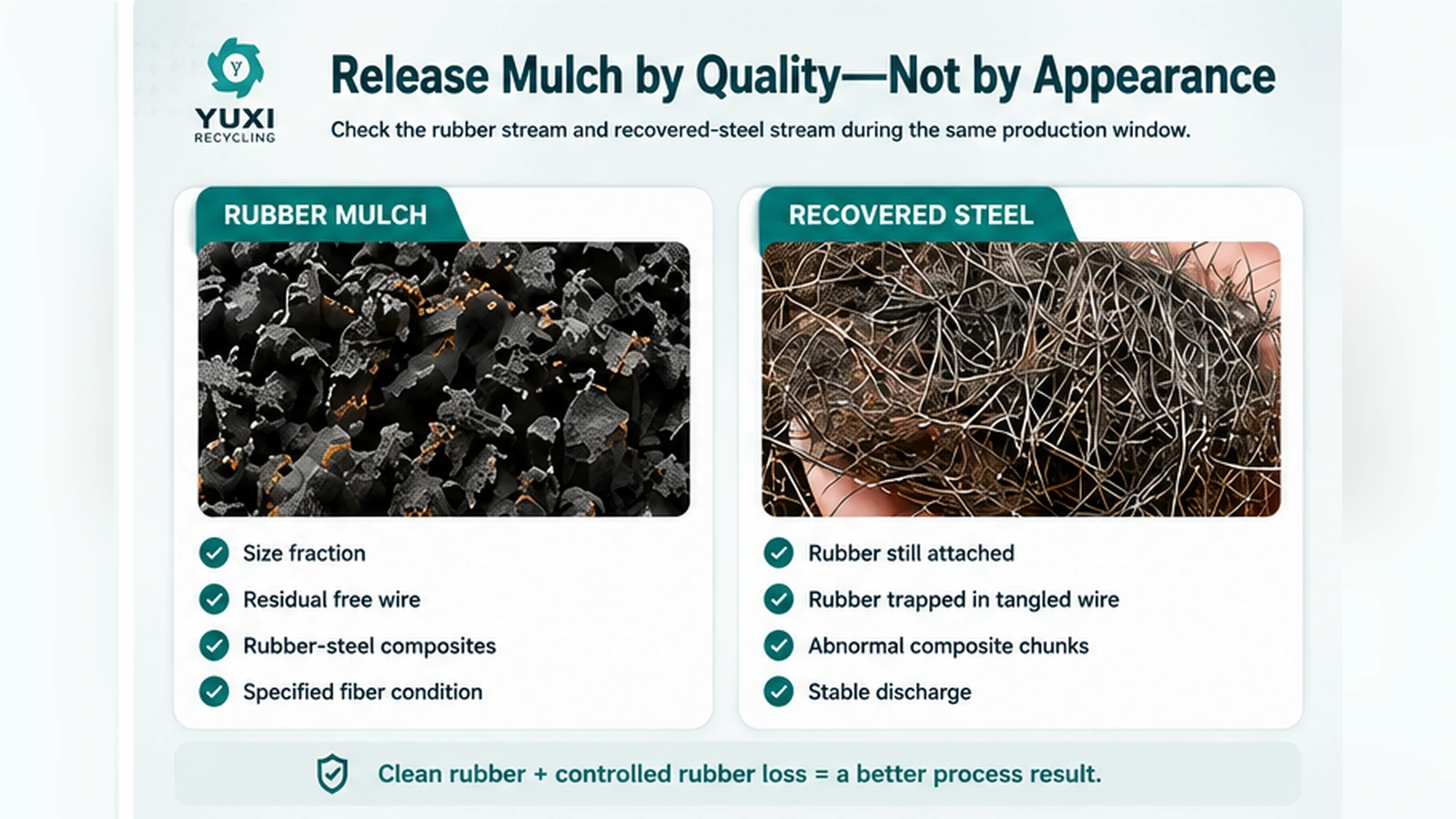
Do not sample the rubber only. Recovered wire should be checked for attached rubber and rubber trapped in tangled steel. A line can make very clean mulch by aggressively removing every steel-containing bundle while losing too much usable rubber into the wire stream. Recovered-steel cleanliness and mulch cleanliness are related, but they are not the same KPI.
Sampling frequency should increase after a meaningful process change: a major tire-mix change, cutter/screen service, magnetic adjustment or throughput change. The first output after major maintenance or a setting change should be held until a quick verification sample confirms that the process is back inside the release condition.
Wire-Free Rubber Mulch Is Not the Same as Crumb Rubber
Wire-free rubber chips or mulch are a coarse/intermediate product with the major steel removed. Crumb rubber is finer and normally requires more complete removal of textile fiber and residual contamination.
Steel is ferrous and can be recovered magnetically after liberation. Textile reinforcement is flexible, non-magnetic and often remains with the rubber until finer size reduction releases it. That is why the product can meet a wire-free target without automatically meeting a low-fiber crumb-rubber specification.
YUXI’s rubber granulation and fiber removal system is the downstream process for that duty. Its live page lists 1–5 mm rubber crumbs and removes fiber through airflow or screening. That is a different target from the 10–30 mm mulch listed on the tire wire steel separation system.
Whether visible fiber is acceptable in mulch depends on the customer. If fiber matters to the market, write the condition into the mulch specification instead of assuming that “wire-free” covers it.
Can Wire-Free Rubber Mulch Be Sold Directly?
Yes—when the material meets the buyer’s required size and contamination limits. Industry processors screen wire-free rubber chips into product fractions for direct sale, while other plants use the same material as feed for crumb rubber or other downstream products.
The commercial decision is where processing should stop. If the customer wants coarse screened mulch, further granulation can add energy, wear and equipment cost without adding value for that order. If the customer wants fine low-fiber granules, the mulch is only an intermediate feed.
Use a Production Control Plan, Not One Perfect Handful
| Checkpoint | What to record | What it tells you |
|---|---|---|
| Incoming / lot start | Tire mix, unusual contamination, bead-preprocessing status | Why process load may differ from the previous lot |
| After primary shredding | Chip distribution, recurring oversize, feed surges | Whether the liberation stage receives stable feed |
| Before magnet | Free wire, rubber-coated wire, large composites | Actual steel-liberation condition |
| Finished mulch | Sample mass, size fraction, residual steel form, specified fiber condition | Whether product can be released |
| Recovered steel | Rubber carryover, tangling, composite chunks | Whether usable rubber is being lost with wire |
Take several samples across a stable production period rather than selecting one clean handful. There is no universal sampling duration for every plant; the period should be long enough to include normal chamber loading, conveyor flow and recurring feed variation.
Store photos and basic measurements with the production lot. Over time, these records become a plant-specific baseline. They are especially useful after wear-part changes, feedstock changes or complaints from a customer because the team can compare the current output with a known-good lot.
Control Rework Without Losing Throughput
When a mulch lot fails inspection, isolate the affected material before it is blended into released product. Classify the defect first, then route it to the stage that can actually fix it.
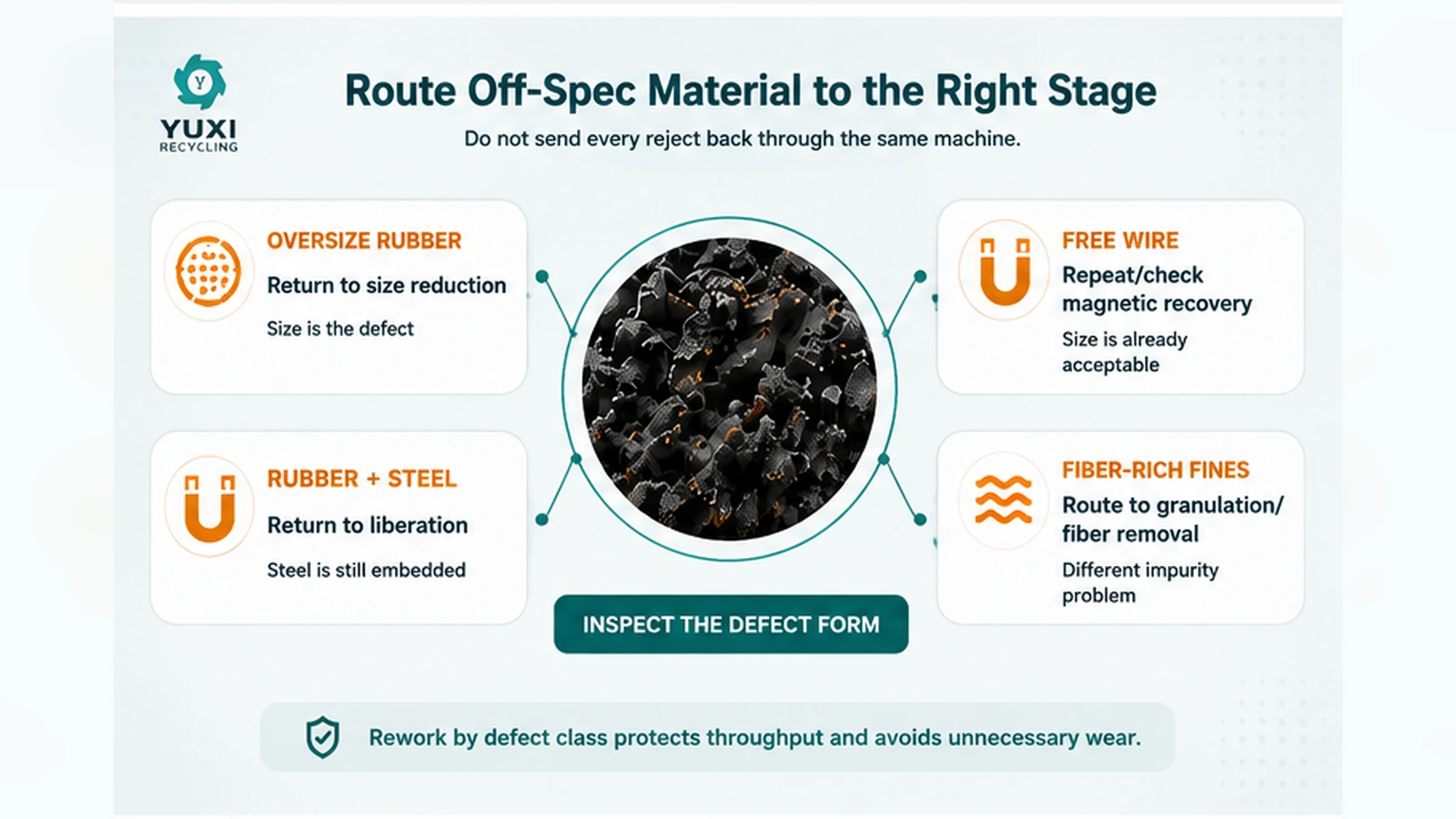
- Oversize rubber: return to additional size reduction.
- Rubber-steel composite: return to the steel-liberation stage.
- Free wire in correct-size mulch: inspect or repeat magnetic recovery.
- Fines: route to a separate product or downstream granulation path.
- Fiber-rich rubber: send to fiber-liberation/removal processing if the buyer requires lower fiber.
- Rubber trapped in recovered wire: consider wire cleaning/reclaim rather than automatically sending tangled steel back through the rasper.
A common commissioning pattern is clean mulch at reduced feed and poorer product near the desired production rate. At higher load, chamber conditions, screen recirculation, conveyor burden and magnetic loading can all change at once.
If quality falls, freeze the affected lot and inspect the defect form. Embedded steel points upstream to liberation. Free wire points toward recovery. Wide size distribution points toward screening. Quality loss only during surges points toward feed control or line balance.
Change one main variable, stabilize the line, then sample again. Changing feed rate, rasper condition, magnetic position and conveyor speed at the same time can produce a better batch without revealing what actually fixed the problem.
Real-Line Context: The Product Is Created by the Whole Route
The 3T/H waste tire recycling machine is useful as a YUXI line-level reference because it shows the environment in which mulch quality is created: reduction, conveying, separation and downstream handling operate as one system. It should not be used to invent a universal screen size or separation setting; its value here is showing why quality must be verified under complete-line flow.
Release the Product Against the Specification, Not Its Appearance
At the end of a production lot, “looks clean” is not a release rule. Confirm the screened size fraction, residual-steel condition and any customer-specific fiber requirement using the agreed sampling method. Check the recovered-steel stream for abnormal rubber carryover at the same time.
If the lot is out of specification, identify it, route it for the correct rework, and re-sample before release. That discipline is what turns a shredding line into a repeatable industrial wire-free rubber mulch process.
For landscaping products, released black mulch may continue to a coloring/drying line and then to bagging. Other customers may buy screened black material directly or use it as feed for further recycling. These finishing operations should come after the core size and steel condition has been confirmed, so an off-spec batch is not made more expensive before the problem is discovered.
Send your tire mix, target mulch size, required throughput, residual-steel acceptance rule and whether the product will be sold as mulch or processed into crumb rubber. The line configuration should be built around the product you need to release.